
Enough Is Enough.
The brands with the longest waitlists aren't the ones trying hardest to grow.

Last fall I was headed from Steamboat to Crested Butte when I decided to pull off in Leadville and finally stop at the Melly store.
If you spend any time in the outdoor world, you know what a Melly is. A Melanzana MicroGrid hoodie, one of the most coveted pieces of functional outerwear in the industry. You can’t buy one online. You can’t order from a catalog. I walked in already thinking about colors — Melanzana does custom combinations and I’d been mentally building my order since Copper Mountain. As the entry bell tinkled, a woman looked up and asked, pleasantly, if I had a reservation. Not an appointment: a reservation. Like a restaurant. I didn’t. She nodded like this happened fifty times a day. It probably does. I got back in my truck.
Melanzana has been making fleece in Leadville since 1994: every piece, by local workers, in a building a mile from the store. They could have scaled years ago. The demand has always been there. They didn’t do it. They stayed in Leadville, kept making things there, and as outdoor brand after outdoor brand chased growth, raised capital, and hired PR firms, Melanzana stayed exactly where it was and grew more desirable for it.
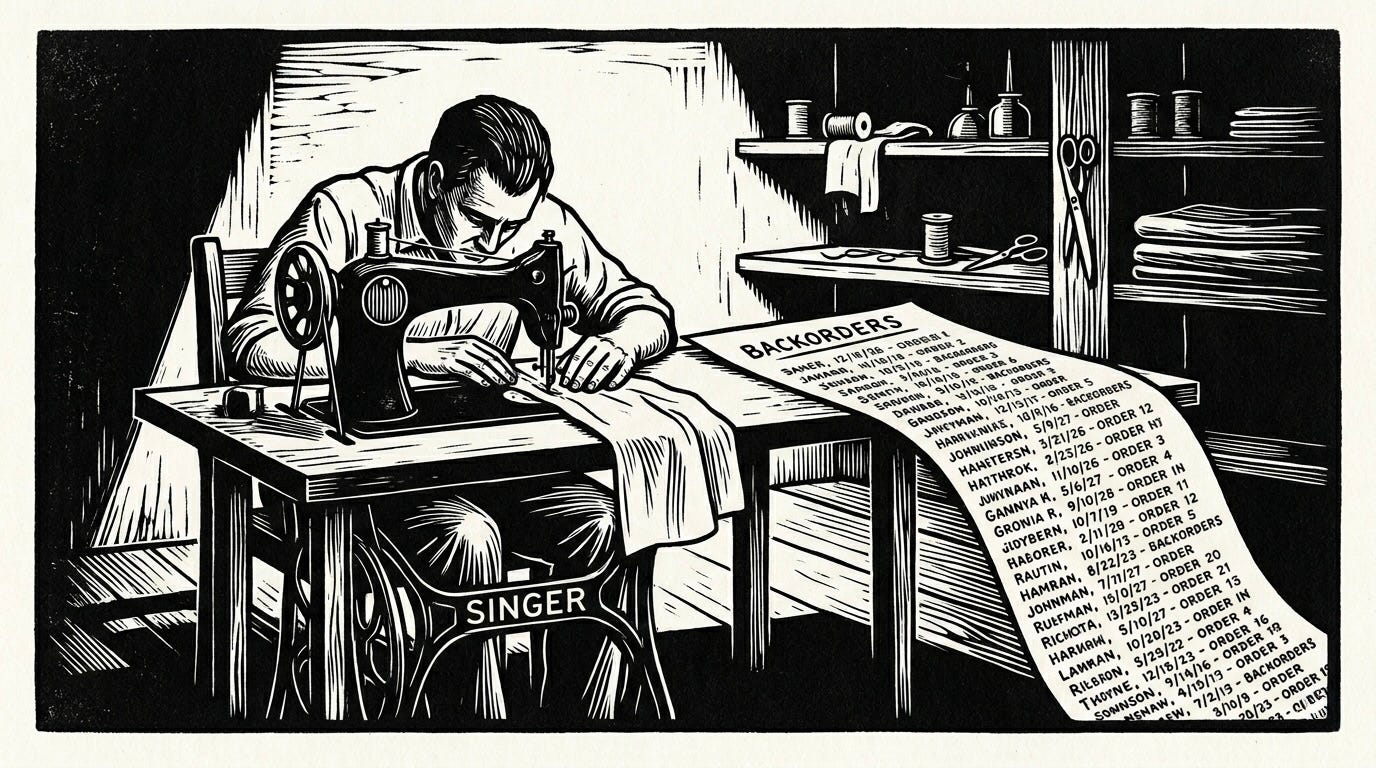
A few weeks ago I ordered a midlayer from Sambob. Sam Roberts was a wildlife biologist and backpacker who learned to sew during COVID while living in Logan, Utah. He started making fleeces for friends. The company is now based in Portland, Maine. The tagline is “Designed by you, made by me.” When I placed my order I was told the wait was eight to ten weeks. There was no apology. No pitch to sign up for early access. The implication was quiet and completely confident: this is how long quality takes. I said fine.
Melanzana and Sambob are two different species of the same instinct. Melanzana is protecting place: Leadville, local production, controlled access as a side effect of knowing exactly what the company is for. Sambob is protecting craft: one garment, one person, made to order by a local craftsperson making thirty dollars an hour from day one, a wage that treats the work as worth doing. Both are asking the same question that modern business rarely asks: what are we unwilling to sacrifice in order to become bigger?
I’ve spent almost a decade investing in outdoor recreation and lifestyle brands. My job, in the simplest terms, is to find companies that can grow, and bet on the ones that will. But I keep getting distracted by this category entirely: companies that appear strangely uninterested in growing at all.
Tom Morgan Rodsmiths built fly rods by hand in Bozeman, Montana, at a pace that ensured you’d wait months for one. Tom passed away in 2017, but the company, run by his wife Gerri, still operated the same way until it closed early this year. Rivendell Bicycle Works founder Grant Petersen has been making steel bicycles in Walnut Creek, California since 1994, selling through a printed catalog to a devoted following that doesn't need convincing. “Once you’re big,” Petersen told Nativve in 2023, “you have to care more about market support than the product. It can’t be any other way.”[1] Dehen 1920 has been knitting athletic sweaters in Portland since 1920. Gary Hilde, the company’s president and master knitter sums it up this way: “We’re a throw-away society. But our stuff lasts.”[2]
These companies aren’t struggling. They’re waitlisted.
The standard business reading is that they’re leaving money on the table. The market is telling them to grow. They’re not listening.
I’ve started to think the reading is backwards.
These companies aren’t failing to capitalize on demand. They’ve made a different calculation about what they’re optimizing for. Not revenue per square foot. Not total addressable market. Not year-over-year growth. They’re optimizing for something harder to measure: craftsmanship, founder autonomy, the quality of the work, the durability of what they make, the culture of the people who make it. They’ve decided, quietly and without press releases, that they already have enough.
That sounds soft until you look at what happened to the alternative.
The outdoor industry spent most of the last decade chasing scale. The pandemic poured fuel on it — factories expanded, inventories ballooned, private equity arrived, and everybody was a genius for about eighteen months. Then came the contraction. Layoffs. Bankruptcies. Brands that had been growing 40% a year suddenly couldn’t move inventory. Companies that had raised venture rounds at sky-high valuations found themselves in restructuring conversations. The growth thesis worked, until it didn’t.
Against that backdrop, a fleece company in Leadville that still requires appointments looks less eccentric and more prophetic.
There’s a philosophical tradition behind what these brands are doing, even if their founders would never frame it that way. Brunello Cucinelli has spent forty years building one of the world’s most admired luxury brands from a single medieval Umbrian village. He calls his approach “humanistic capitalism.” He has a rule: no work communications after 5:30 pm. “Don’t get caught in all of these daily tasks,” he told Fortune in 2021. “To me, tasks kill the human soul.”[3] He doesn’t mean it as work-life balance advice. He means the work itself must serve something larger than output. His company has grown steadily, never compromised its production ethics, and it took decades. He could have pushed harder. He decided not to.
There’s also something about friction that the slow goods companies understand intuitively. Modern commerce is designed to eliminate inconvenience. Everything is available immediately. Anything can be delivered overnight. And yet some of our most meaningful experiences involve waiting. Camping permits. Powder mornings. A permit tag after years of failed draws. Nobody tells stories about two-day shipping. People tell stories about finally getting a Melly. About the rod they waited three months for and have fished for twenty years. About a Dehen sweater that still fits the same way it did in 1987. In high school, I once waited for months for a hand-made Burton snowboard to come out of a little factory in Vermont. When it finally arrived, personally signed by Jake, it had an almost totemic presence. Nothing like anything I could feel running down to Evo and grabbing one off the shelf today. Friction and scarcity don’t just build demand — they build meaning. The waiting creates a relationship with the thing.
I’ve thought about all of this more lately because I recognize something in myself. I moved to Steamboat Springs because I wanted the life that’s available here, not because it was strategically optimal for building an investment fund. I back companies that grow; that’s the job. But I find myself drawn, again and again, to the founders who seem to have already answered the question I keep circling: how much is actually enough?
Enough revenue. Enough employees. Enough complexity. Enough stress. At some point, more of each of those things becomes a cost, not a benefit, and the founders who figure that out early tend to build things that last.
The slow goods movement isn’t anti-business. It’s not nostalgia. It’s a different theory of what a business is for. Not a vehicle for maximizing output, but a structure for doing work you care about, at a pace you can sustain, making things worth making, for people who appreciate them. That’s not a mainstream philosophy in 2026.
In an industry that spent the last decade learning what too much looks like, that may be the wisest one of all.
I’m Andrew Luter, founder of Rio Chato Investments. We back early-stage outdoor recreation and lifestyle brands — the kind of companies building gear and experiences for people who’d rather be outside. I’m based in Steamboat Springs, Colorado, which is basically a full-time reminder of why this space matters.
Sources
Sam Waller, “An Interview with Grant Petersen, Founder of Rivendell Bicycle Works,” Nativve, July 6, 2023
Zach Dundas, “Dehen Takes a Chance that ‘Made in Portland’ Still Means Something,” Portland Monthly, August 2011
Emilie Hawtin, “Inside Brunello Cucinelli’s Vision for ‘Humanistic Capitalism,’” Fortune, April 4, 2021
Jason Blevins, “The Melanzana Mystique,” The Colorado Sun, July 28, 2025
Louder for the people in the back! I think it comes down to how founders and entrepreneurs define success for themselves. Unfortunately, most founders launch and then look around at the well-told success stories of other founders and follow suit.
The reality is that we can build a meaningful business that supports a great life by following our own playbook based on our definition of success.
Great post. I’d love to know more outdoor brands that follow a similar ethos and approach. I find it a nice counter to the giants of the industry (ie Patagonia) who exist in the irony of still touting quality yet continue to also seek growth.