
You Have to Suck First
On Saltwater, Humility, and the Part of Learning Nobody Photographs

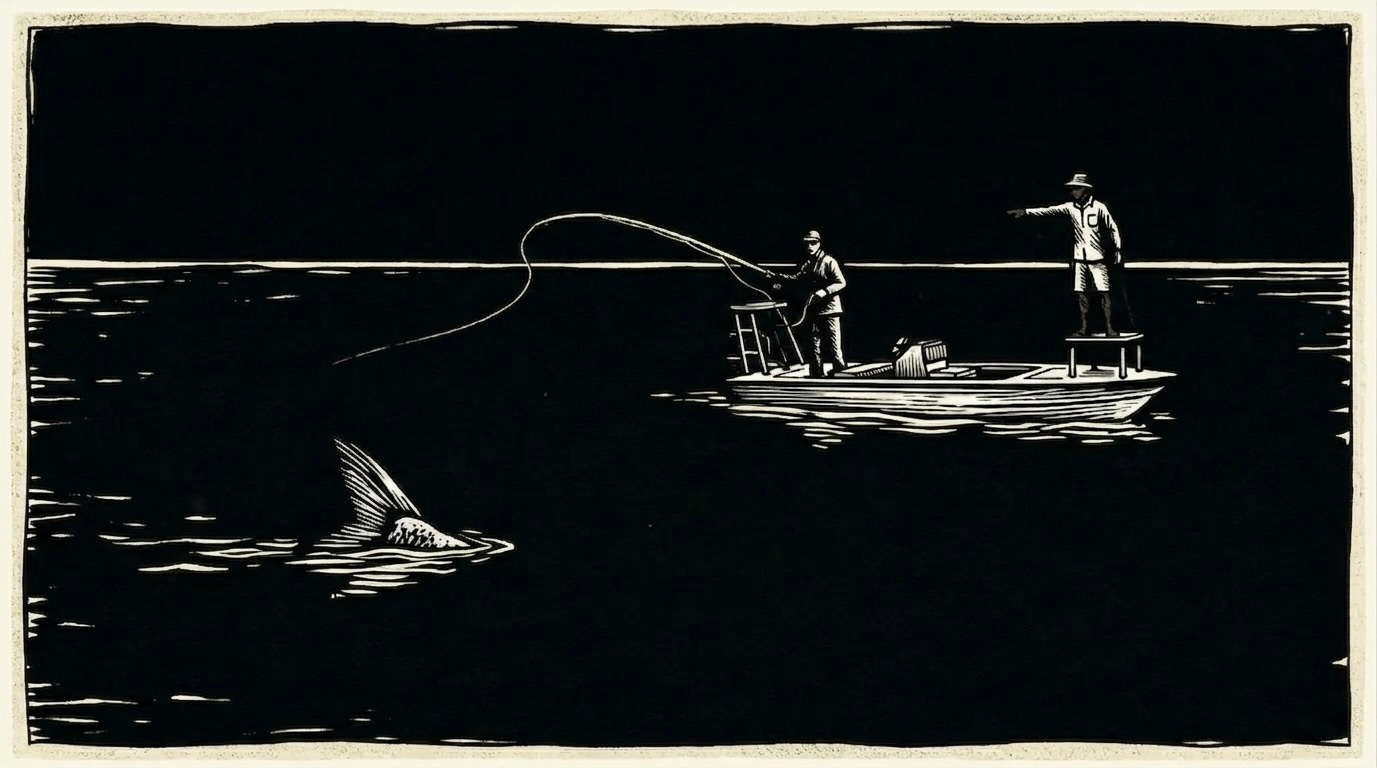
The outdoor industry worships mastery. The athletes we sponsor, the gear we build, the imagery we use -- it’s all peak performance, summit reached, line perfectly laid. What we don’t talk about is the part before all of that. The part where you’re flailing. I am in that part right now. I’m writing this from Belize, where I have once again been humbled by permit, and it is teaching me more about early-stage investing than anything I’ve read in the last year.
I have been fly fishing for a long time. Freshwater. Freestone streams. I know how to read water, mend a line, match a hatch. None of that prepared me for saltwater flats. The physics are different. The fish are faster, spookier, harder to see. The cast has to be precise in a way that forgives nothing. The wind that makes the scenery beautiful is the same wind that blows your fly into the back of your head.
What a permit cast requires, specifically, is this: fifty to seventy feet of line laid down accurately, into wind, dropping a small fly within a foot of a moving target -- without sound, without false starts, without a leader that lands too hard. The fish sees everything. One imperfect delivery and the shot is over. I have made a lot of imperfect deliveries this week.
I have been fishing saltwater for about a year now. I am still not good. My guide is patient. I am not always patient with myself.
But here is what I keep coming back to: the experience of being genuinely, visibly, humblingly bad at something is one I had quietly stopped having. And I think that was making me worse at my job.
When you spend enough time in early-stage investing, you start to get comfortable with your pattern recognition. You’ve seen the pitch before. You know what a good founder looks like, what a stretched valuation looks like, what a product that won’t survive its second season looks like. That recognition is valuable. It is also, if you’re not careful, a way of never being surprised. Never being wrong in a way that teaches you something new.
Saltwater doesn’t let me pattern match. Every flat is different. Every fish is different. The experience keeps forcing me back to zero in a way that is uncomfortable and, I’ve come to believe, necessary.
Here is what I’ve learned from a year of being bad at something new:
1. Sucking is the only honest starting point.
There is no shortcut from not knowing to knowing. Founders understand this better than most. The ones who pretend otherwise -- who project competence they don’t have yet, who oversell their experience, who won’t admit what they don’t know -- they’re the ones who get into trouble when the gap between performance and reality closes fast. The best founders I back have always been willing to say what they don’t know yet. That’s not weakness. That’s the first honest step.
2. Staying in it after you blow the shot is the whole game.
I have blown shots at permit. At bonefish. At fish I spotted first and still couldn’t put the fly where it needed to go. You can leave the flat. You can blame the wind, the guide, the gear. Or you can strip your line, reset, and wait for the next one. The founders who build something durable are not the ones who never miss. They’re the ones who keep showing up after they do.
3. Your existing competence is often a liability.
I keep trying to apply freshwater instincts to saltwater situations. It fails consistently. There is a version of this in every industry pivot, every new market entry, every product category expansion. What got you here genuinely does not always get you there. The operators who move into new categories successfully are the ones willing to treat their existing expertise as a starting point, not a solution.
4. Being bad at something makes you a better evaluator of people who are good at it.
I understand guides differently now. I understand what they’re seeing that I’m not seeing, what they’re doing with the rod that I can’t replicate yet, how much of their job is managing a client’s frustration as much as finding fish. That texture -- the lived experience of incompetence in a domain -- makes you a sharper judge of real skill when you see it. I think about this when I’m evaluating founders. The ones who have been operators, who know what it feels like to not understand something and have to figure it out anyway -- they’re different. You can tell.
5. The outdoor industry needs to tell the truth about the middle.
We are good at celebrating the first attempt and the eventual mastery. What we skip is the long middle -- the part that looks like failure from the outside and is actually just the work. The brands that build real community hold space for that middle. They don’t only sell the summit. They sell the process of getting there, including the parts that aren’t photogenic. That honesty is what turns customers into believers.
6. Deliberately putting yourself somewhere you’re bad is a discipline worth protecting.
The most interesting people I know -- founders, investors, operators -- all have something they’re currently learning from scratch. Not maintaining. Not optimizing. Starting. It keeps something alive in the way you think. It makes you less certain, more curious, and better at the parts of your work that require you to sit with not knowing long enough to figure something out.
I am going back to the flats. I will probably blow more shots. At some point, if I stay in it long enough, I will start to understand what I’m doing wrong. And then, slowly, I will get better.
That arc -- from not knowing to knowing, through the long uncomfortable middle -- is the only arc that actually builds anything. In fishing, in business, in anything that matters.
The outdoor industry photographs the beginning and the end. The brands that tell the truth about the middle are the ones worth backing.
What’s something you’re currently bad at that you’re showing up for anyway?
I’m Andrew Luter, founder of Rio Chato Investments. We back early-stage outdoor recreation and lifestyle brands -- the kind of companies building gear and experiences for people who’d rather be outside. I’m based in Steamboat Springs, Colorado, which is basically a full-time reminder of why this space matters.
#OutdoorIndustry #EarlyStageInvesting #FounderAdvice #OutdoorBrands #FlyFishing #RioChato #Entrepreneurship #Beginner
Loved this. Thanks for sharing.